
5 Best Popmenu Alternatives for Restaurants (2026)
Last Updated: September 1, 2026
Across Reddit discussions and reviews on G2 and Trustpilot, restaurant owners commonly cite concerns about Popmenu's pricing, platform flexibility, customer support, and overall value.
If you're experiencing similar challenges, exploring other restaurant management platforms can help you find a solution that better fits your operational needs, budget, and long-term growth.
MENU TIGER streamlines daily restaurant operations with an affordable all-in-one solution, Owner.com helps restaurants increase direct orders without relying on third-party marketplaces, Toast simplifies complex restaurant operations, SpotOn combines operational tools with customer engagement, and Square offers an affordable POS and online ordering platform.
Explore each option below to find the best fit for your restaurant.
TL; DR: Which Popmenu alternative should you choose?
The best Popmenu alternative depends on your restaurant's goals, operational needs, and growth priorities:
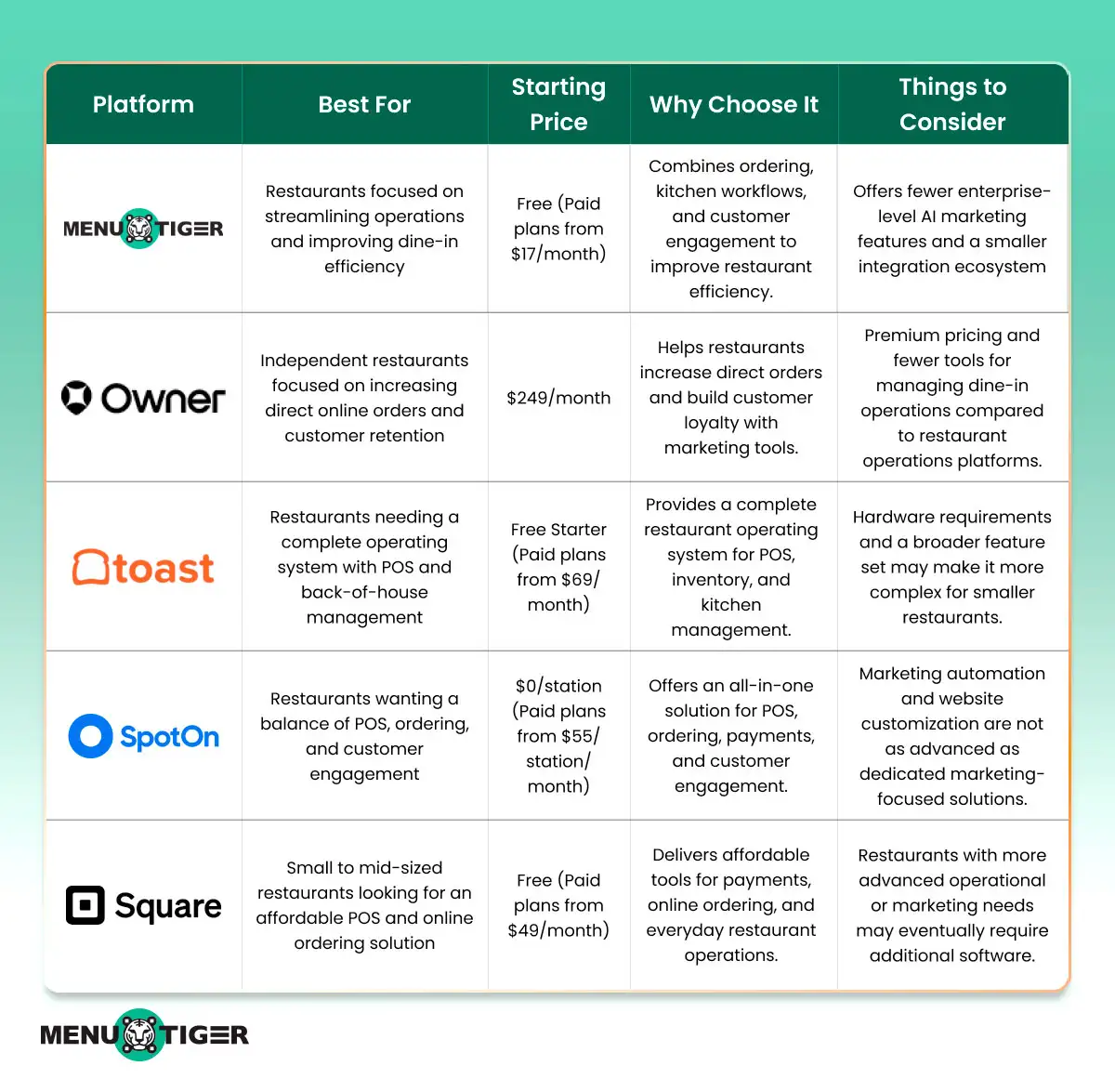
- MENU TIGER is ideal for a budget-friendly way of improving ordering efficiency, dine-in experiences, and daily restaurant workflows.
- Owner.com is a great fit for growing direct online orders and strengthening customer retention.
- Toast works best if you need a complete restaurant operating system with advanced POS and back-of-house management.
- SpotOn is well suited for restaurants seeking a balance of operations, online ordering, and customer engagement.
- Square is a practical choice for businesses looking for an affordable and easy-to-use solution for payments and online ordering.

5 best Popmenu alternatives compared: Features, pricing, and best use cases
1. MENU TIGER
Best for: Restaurants focused on simplifying daily operations, improving service efficiency, and creating a seamless dine-in experience.
MENU TIGER is a restaurant management platform that connects front-of-house and back-of-house operations in one system.
It helps restaurants streamline ordering, improve kitchen workflows, manage customer feedback and overall performance, and increase sales through built-in marketing tools.
What you get:
- Online ordering system
- Interactive digital menu
- Restaurant website builder
- QR code menus and table-side ordering
- Marketing tools (email, SMS, and promotions)
- Customer feedback management
- POS, payment, and delivery system integrations
- Analytics and sales insights
- Branding and white-label customization
- Kitchen Display System (KDS)
- Table management
Pricing:
- Freemium: 0$
- Regular: $17
- Advanced: $46
- Premium: $119
| Pros | Cons |
| More affordable pricing, including a free plan | Less comprehensive restaurant marketing automation than Popmenu |
| Stronger operational tools, including QR ordering, table-side ordering, KDS, and table management | Less advanced CRM and customer engagement features |
| Commission-free online ordering helps maximize revenue | Smaller third-party integration ecosystem |
| Better suited for improving front-of-house and back-of-house coordination | Less emphasis on restaurant website SEO and content marketing |
| Combines ordering, operations, and marketing in one platform | More operations-focused than marketing-focused |
Simple rule of thumb:
Think about where your biggest challenge is. If it's improving service speed, managing orders more efficiently, and connecting your dining room with the kitchen, MENU TIGER is the better fit. If attracting more customers through marketing and website engagement matters more, Popmenu has the advantage.
2. Owner.com
Best for: Independent restaurants looking to grow direct online orders, customer loyalty, and repeat business.
Owner.com is an all-in-one restaurant platform that helps restaurants increase direct sales through branded online ordering, restaurant websites, loyalty programs, and automated marketing.
It focuses on customer retention and revenue growth while reducing dependence on third-party marketplaces.
What you get:
- Restaurant website builder
- Online ordering
- Online menu
- Restaurant SEO
- Email and SMS marketing
- Marketing campaigns
- Reviews management
- Loyalty and rewards
- AI phone ordering
- Smart upsells
- Branded restaurant app
- POS integrations
- Reporting and analytics
Pricing:
- Flexible: $249/month + 5% restaurant fee per order
- Fat Rate: $499/month with no additional restaurant fees
| Pros | Cons |
| Stronger direct online ordering and customer retention tools | Less focused on brand building and website-driven SEO |
| AI-powered ordering, upsells, and marketing automation | Fewer social media and content marketing tools |
| Branded app and loyalty features | Limited dine-in engagement features compared to Popmenu |
| Helps increase repeat orders and reduce third-party dependency | Less emphasis on restaurant storytelling and digital presence |
Simple rule of thumb:
Owner.com shines when your growth strategy revolves around direct online orders and keeping customers coming back. Restaurants that place a greater emphasis on building a strong online brand and engaging guests through their website may find Popmenu a better match.
3. Toast
Best for: Restaurants that need a complete operating system for managing orders, payments, kitchen workflows, and multi-location operations.
Toast is a restaurant management platform built around its point-of-sale system. It helps restaurants manage front-of-house and back-of-house operations through integrated ordering, payments, kitchen management, inventory, and reporting tools.
What you get:
- Restaurant POS
- Online ordering
- Digital storefront and website
- Branded mobile app
- Kitchen Display System (KDS)
- Loyalty programs
- Email marketing
- Advertising tools
- Guest CRM
- Gift cards
- Inventory management
- Multi-location management
- Reporting and analytics
Pricing:
- Starter Kit: $0
- Point of Sale: $69/month
- Build Your Own: Custom pricing
| Pros | Cons |
| Comprehensive restaurant operations with POS, KDS, inventory, and team management | Less marketing-focused than Popmenu |
| Stronger back-of-house and multi-location management tools | Less emphasis on website customization and SEO |
| Built-in payments, loyalty, CRM, email marketing, and advertising | Higher setup costs due to hardware requirements |
| Extensive hardware and integration ecosystem | More complex for smaller restaurants |
| Better suited for scaling restaurant operations | May be excessive for restaurants focused mainly on marketing and online ord |
Simple rule of thumb:
Toast is designed to run nearly every aspect of a restaurant, from payments and inventory to kitchen operations. If you already have your operational tools in place and want to strengthen your marketing instead, Popmenu is likely the more relevant investment.
4. SpotOn
Best for: Restaurants looking for an all-in-one platform that combines customer engagement, online ordering, and restaurant operations.
SpotOn is a restaurant management platform that helps businesses manage daily operations while improving customer relationships.
It combines POS, online ordering, marketing, loyalty, and payment solutions to help restaurants streamline service and grow revenue.
What you get:
- Restaurant POS
- Online ordering
- Website builder
- KDS
- Reservations and waitlist
- Loyalty programs
- Marketing tools
- Gift cards
- Reporting and analytics
- Employee management
- Payment processing
Pricing:
- All-In Plan: $0/station per month
- POS Essentials: $55/station per month
- Build Your Own: Custom pricing
| Pros | Cons |
| Stronger cloud POS capabilities for restaurant operations | Less focused on interactive menus and website-driven marketing than Popmenu |
| Better online ordering and service workflows | Fewer AI marketing capabilities |
| Includes reservations, loyalty programs, and table management | Less emphasis on marketing automation and customer engagement |
| More affordable entry pricing | Website builder features may be less robust |
| Better suited for restaurants needing POS and operational tools | May require additional tools for advanced digital marketing needs |
Simple rule of thumb:
Restaurants looking for a balanced platform that covers POS, online ordering, reservations, and day-to-day operations will get more value from SpotOn. Popmenu is better suited for businesses that see digital marketing and customer engagement as their primary growth drivers.
5. Square
Best for: Small to mid-sized restaurants looking for an affordable POS system with built-in ordering, payments, and essential business management tools.
Square is a restaurant technology platform that combines point-of-sale, payment processing, online ordering, marketing, and customer management tools.
It helps restaurants manage daily transactions, accept digital orders, and build customer relationships through an easy-to-use ecosystem.
What you get:
- Restaurant POS
- Online ordering
- Digital menus
- Website builder
- Loyalty programs
- Email and SMS marketing
- Customer directory and CRM
- Gift cards
- Reporting and analytics
- Inventory management
- Employee management
- Third-party delivery integrations
Pricing:
- Square Free: $0
- Square Plus: $49/mo.
- Square Premium: $149/mo.
| Pros | Cons |
| Affordable and easy-to-use POS system | Less focused on restaurant marketing and brand building than Popmenu |
| Strong payment processing and online ordering tools | Limited website customization and SEO features |
| Free entry-level plan for small restaurants | Fewer advanced customer engagement tools |
| Built-in loyalty, CRM, and marketing features | Less comprehensive restaurant operations than Toast |
| Flexible hardware options and integrations | May require additional tools for advanced restaurant workflows |
Simple rule of thumb:
If you're opening a restaurant or upgrading from a basic POS, Square offers an affordable and straightforward way to manage payments and online orders. Popmenu makes more sense once your priority shifts toward expanding your digital presence and marketing your restaurant more effectively.
How to select the right online ordering system for your business
1. Identify what you need to improve with Popmenu
Start by evaluating what is missing from your current setup. Are you looking for stronger restaurant operations, better order management, more flexible pricing, deeper restaurant POS capabilities, or more advanced customer retention tools?
Pro tip: Don’t choose an alternative based only on the number of features it offers. Choose one that solves the specific challenges affecting your restaurant’s daily workflow and revenue growth.
2. Match the platform’s strengths with your restaurant goals
The best alternative is not necessarily the one with the most capabilities, but the one that aligns with your restaurant’s biggest priorities in terms of restaurant management and growth .
For example:
- Choose an operations-focused platform if improving ordering speed, kitchen coordination, and service efficiency is your priority.
- Choose a marketing-focused solution if your goal is increasing customer engagement, repeat visits, and online visibility.
- Choose a POS-centered platform if you need stronger payment, inventory, and multi-location management.
3. Read verified customer reviews
Before committing to any platform, review feedback from real restaurant owners on trusted software review sites like G2 and community discussions on Reddit.
Look for repeated feedback patterns rather than isolated reviews. Consistent comments from multiple users are usually the strongest indicator of a platform’s actual strengths and weaknesses.
4. Evaluate the total value, not just the price
Monthly subscription fees are only one part of the investment. Consider payment processing fees, hardware costs, commission structures, contract terms, and whether the platform helps generate more revenue or reduce operational costs.
The cheapest restaurant technology is not always the most cost-effective. Focus on the platform’s ability to improve efficiency, increase direct orders, and support business growth.
5. Consider scalability and long-term needs
A restaurant order system that works for a single restaurant may not support future growth.
Consider whether the solution can handle additional locations, higher order volumes, more employees, and expanding operational needs.
The best alternative is the one that works for you.
MENU TIGER is ideal for improving ordering workflows and dine-in efficiency, while Owner.com focuses on growing direct sales and customer retention.
Toast offers a complete restaurant operating system, SpotOn provides a balance of operations and engagement tools, and Square delivers an affordable solution for smaller restaurants.
Before choosing a platform, evaluate your biggest challenges, required features, and future growth plans.
The right solution should not only replace Popmenu but also help improve efficiency, increase revenue, and support your restaurant’s long-term success.
FAQs
Disclaimer: MENU TIGER is not affiliated, associated, authorized, endorsed by, or in any way officially connected with Popmenu, Owner.com, Toast, SpotOn, Square, or any of their respective subsidiaries or affiliates.

Eulla
Eulla joined MENU TIGER’s Content Team with a foundation in English teaching. She combines language expertise and creativity to produce engaging content that educates audiences and drives meaningful results.
Affiliates




© 2026 Menu Tiger. All rights reserved


