
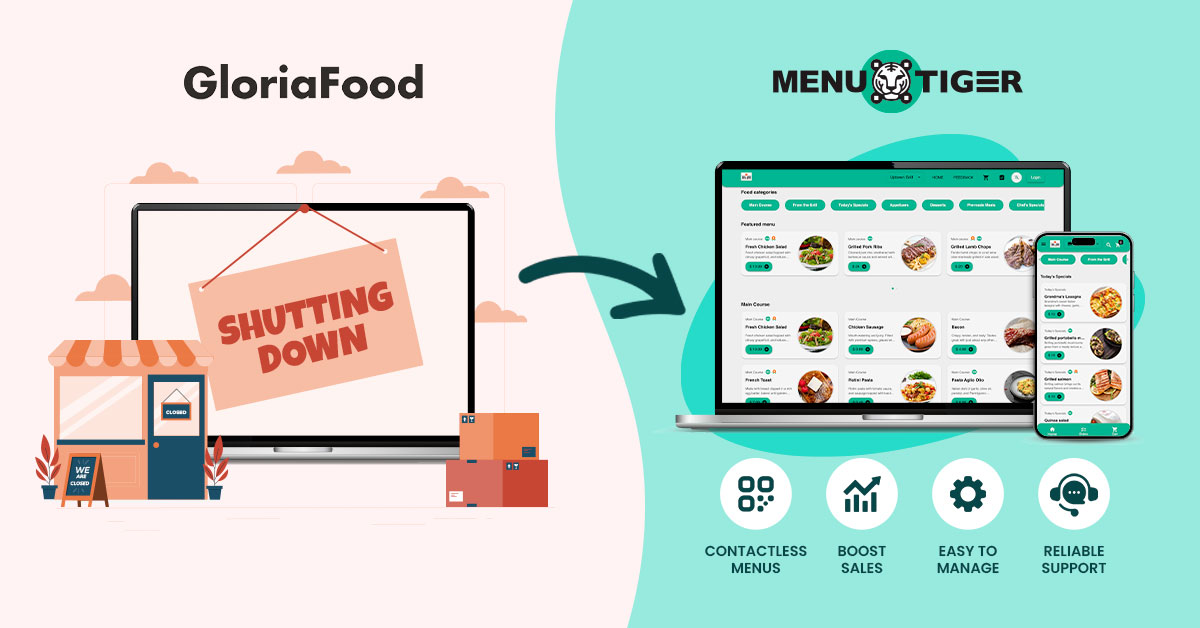
GloriaFood Is Shutting Down: Why MENU TIGER Is The Best Alternative
Last Updated: July 27, 2026
Oracle just announced: Gloria Food is shutting down permanently on April 30, 2027.
This will be a major bottleneck for restaurants relying on the online ordering system.
For current GloriaFood users, this translates to losing access to their menu data, order history, integrations, and everything else that keeps their online ordering workflow running.
The priority now shifts to looking for a smarter alternative that guarantees them a smooth transition and stable online ordering.
This is where the MENU TIGER comes into view. Learn how our restaurant ordering software can help you transition out of GloriaFood and into a familiar system with more flexible solutions.
Why is GloriaFood shutting down?
While no official reason has been announced for the closure, several factors have been discussed by industry observers.
Oracle, a tech giant known for its flagship database software, enterprise cloud infrastructure (OCI) and business application (ERP), acquired GloriaFood in June 2021.
It was integrated into the Oracle Food and Beverage portfolio as “ Oracle Micros GloriaFood Cloud Service.
The goal is to extend the MICROS Simphony cloud POS platform with a native global online ordering and marketing layer to help independent businesses go digital.
But since GloriaFood stands as a Freemium and gets only monetized through their add-ons, compared to Oracle, as an all-in high-margin cloud infrastructure, enterprise and AI-driven products, having a free global online ordering platform for small restaurants does not seemingly fit into what Oracle’s business portfolio wants to achieve.
Oracle has informed its users that GloriaFood services shall retire on April 30, 2027.
What does GloriaFood closure mean for restaurants?
The closure directly impacts your restaurant management operations as a whole, in particular:
- The entire menu is set up
- Order history
- Website integrations
- Ordering link
- Online ordering functionality
It also includes the product groups:
- Online Ordering eStore Cloud Service (both Freemium and paid)
- Point of Sale eStore Cloud Service (plus associated hardware)
- Oracle payment eStore Cloud Service
- Partner agreements tied to the Oracle Restaurants eStore Program
If you're a GloriaFood user, the shutdown announcement may raise important questions about your restaurant's online ordering future.
Whether you're concerned about your menu, customer experience, or daily operations, now is the time to start planning your next steps.
Why MENU TIGER is the best GloriaFood alternative
| Feature | MENU TIGER | Olaclick | UpMenu | Square | Clover |
| AI Menu Maker | ✔YES | ✘NO | ✘NO | ✘NO | ✘NO |
| Easy Migration From GloriaFood | ✔YES (Recreates menu within minutes) | Manual setup required | Manual setup required | Manual setup required | Manual setup required |
| Customer engagement tools | ✔YES (Customer database and engagement tools) | Limited | Basic | ✔YES | ✔YES |
| QR code ordering in dine-in and take-away | ✔YES (Customizable QR codes to match the restaurant branding) | ✔YES | ✔YES | ✔YES | ✔YES |
| Menu availability and modifier management | ✔YES (with advanced tools) | Basic | ✔YES | ✔YES | ✔YES |
| Built-in promotions and discount | ✔YES | ✔YES | ✔YES | Add-ons may be required | Basic |
| Sales Analytics | ✔YES (Detailed dashboard and reporting) | Basic | ✔YES | ✔YES | ✔YES |
Many restaurant owners have already evaluated the best restaurant order system options that can support both continuity and growth, not just a replacement.
One option that has been on their radar is MENU TIGER, a restaurant online ordering system designed to help businesses manage digital menus, QR code ordering, and direct customer orders in one platform.
Instead of simply replicating your existing setup, it focuses on rebuilding and improving our operational experience through:
Faster AI-powered migration
AI menu Maker makes it easier for restaurants to recreate their menu in minutes by uploading their menu photo or PDF to the system.
This takes away hours of manual data entry after switching from GloriaFood.
All-in-one restaurant platform.
The restaurant software combines QR code ordering, commission-free online ordering, digital menu management, promotions, customer engagement, analytics, and AI menu creation in one solution.
Purpose-built for restaurants
Unlike other restaurant ordering software, which commonly have broader POS ecosystems serving many industries, this restaurant software is designed specifically for restaurant operations and digital ordering.
This means its features are meticulously made based on the operational pain points restaurants experienced.
Moreover, what really sets this online ordering software apart is that it’s known for premium benefits for a price range lower than what’s on the market.
It offers enterprise-level features like:
| Kitchen Display System (KDS) | Automatically sends customer orders to the kitchen display, helping staff prepare orders faster while reducing manual errors and paper tickets. |
| Table Management | Manage table occupancy, track dine-in orders, and monitor table status from a centralized dashboard for smoother restaurant operations. |
| Point-of-Sale (POS) integrations | Sync menus, orders, and sales data with Square POS or Loyverse to keep restaurant operations synchronized in real time. |
| e-Payment channels | Accept secure digital payments through integrated gateways including Stripe, PayPal, and Adyen, giving customers multiple ways to pay online. |
| Restaurant Website Builder | Build a branded restaurant website with an integrated digital menu and online ordering system, allowing customers to browse, order, and pay directly from your website. |
Without the high costs or complex setup, this balance allows restaurants to modernize operations without overextending their budget, making it suitable for owners who are planning to transition.

5 benefits of using MENU TIGER’s online menu ordering system
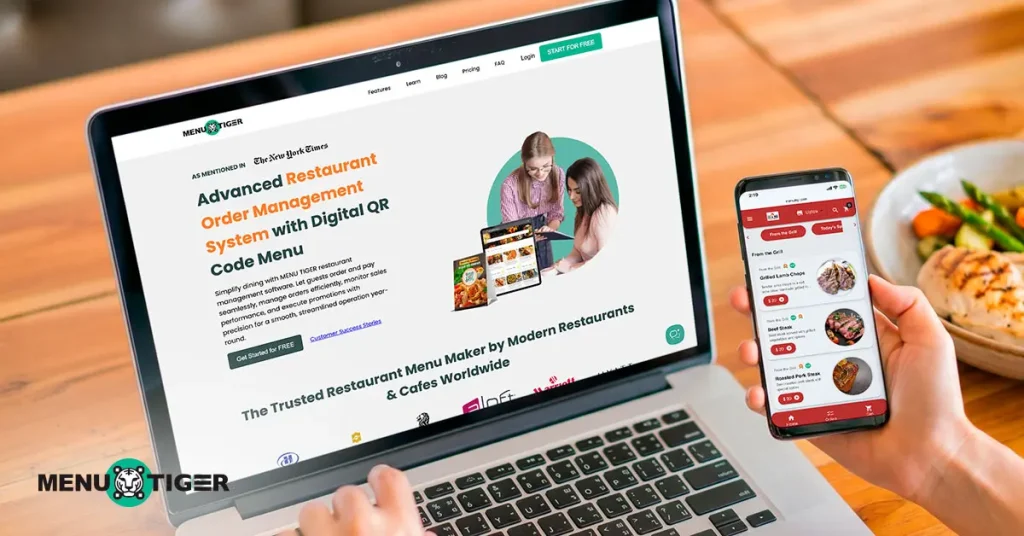
1. Your online ordering stays the same, but becomes easier.
Instead of changing how your customers order, this restaurant management system keeps the same idea but simpler.
Guests can still browse your menu and place orders via a QR code (no app download required), for a faster, more mobile-friendly experience.
The good thing here is that table-specific QR codes can accommodate a number of devices at once.
2. You still take orders directly — just with better control.
Like GloriaFood, the MENU TIGER online ordering platform for restaurants keeps you in control of your orders.
The difference is that you get a more organized system that makes everything easier to manage, track, and adjust in real time.
For instance, once the system receives orders, it goes directly to the Kitchen Display System, so staff can prepare them right away instead of manually confirming them before it is reflected on the back-of-house monitor.
Aside from seamless order tracking, you can instantly update your menu for its availability status or precautions.
3. A more efficient workflow.
Online orders are automatically integrated into your operations, and this naturally reduces the need for manual handling and allows staff to focus more on food preparation and customer service.
If you’re running a small shop with a limited workforce, MENU TIGER adds a restaurant waiter call button system that lets customers send requests directly to the system, without having to station staff in the corner.
It helps to maximize your workforce efficiency with less travel time from the counter to the customer’s table and vice versa.
4. Flexible and easy online menu management.
Menu updates are instantly done, whether adjusting your restaurant pricing options or updating descriptions.
It ensures that the online menu always reflects what is actually available in-store to reduce confusion and order issues.
Aside from easy menu updates, you can also oversee table availability through its table management tool. Using this, you'll be able to analyze your table turnover in one dashboard.
5. Better insights into sales performance.
MENU TIGER provides a comprehensive dashboard for sales performance insights.
These data display gives you a clear understanding of the customer ordering patterns, best-selling items, and peak order times to make better-informed decisions in your menu planning, pricing, and promotions.
Key takeaway
The objective here is for the transition not to feel like starting over.
MENU TIGER’s goal is simple: to keep your online ordering running but make it faster, easier, and more scalable for the long term.
Keep your online ordering running — only better with MENU TIGER
As restaurants move away from GloriaFood, the priority is not to rebuild an online ordering system from zero but to keep it running smoothly while improving performance, control and long-term scalability.
This is where MENU TIGER emerged as a leading alternative. It’s not built to replace but to strengthen what you’ve been using.
This gives restaurants a more flexible all-in-one platform for managing digital menu, processing direct orders and more.
So instead of forcing you to change your operations, it improves what you already do while removing common limitations found in basic ordering systems.
A familiar online ordering on the front end and a more powerful, scalable system on the back end.
Visit MENU TIGER today and keep your modern dining running better.
FAQs

Chevy
Before joining MENU TIGER's Content Team, Chevy has been dabbling in literary arts for five years, specifically creative writing in a theatre company. She loves exploring her creativity through painting, photography, and contemporary dancing.
Affiliates




© 2026 Menu Tiger. All rights reserved