
Front of House vs Back of House: What’s the difference?
Last Updated: August 4, 2026
A restaurant can serve incredible foods and still lose customers because of poor service. At the same time, great hospitality cannot make up for slow kitchen operations or inconsistent meals.
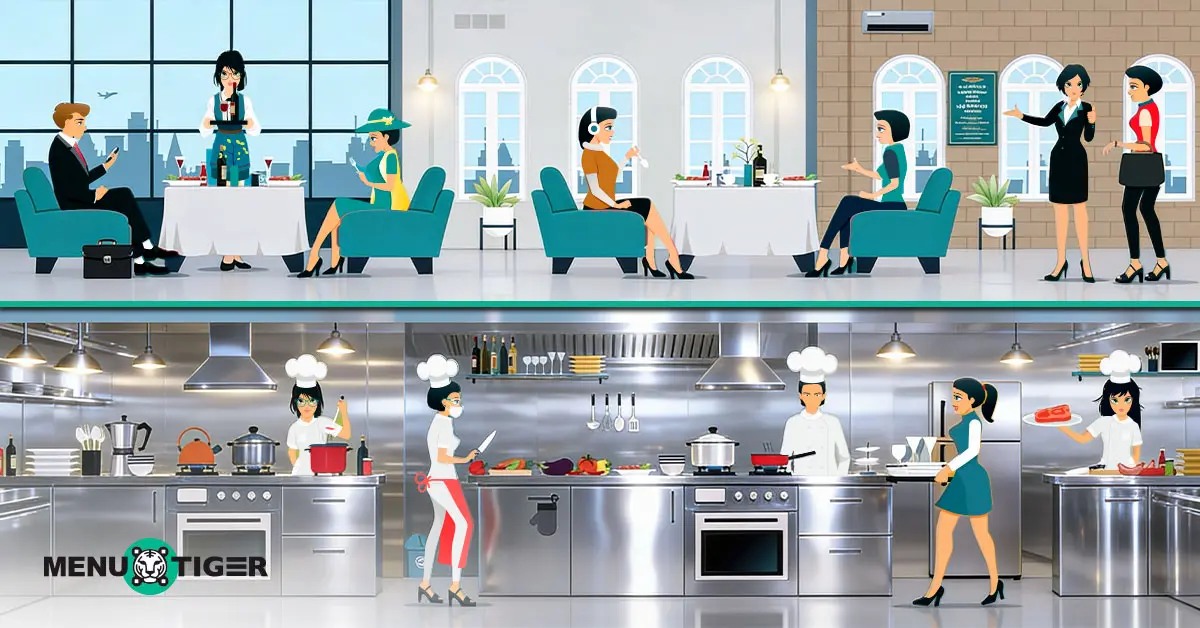
Behind every successful restaurant are two departments working together to create a smooth dining experience: Front of House vs Back of House.
FoH teams focus on customer interaction and service, while BoH teams manage food preparation, kitchen workflows, and operational efficiency behind the scenes.
The challenge for restaurant owners is not deciding which department matters more — it’s making sure both sides operate in sync to improve service speed, customer satisfaction, and profitability.
Front of House vs Back of House: A quick comparison
| Front of House (FoH) | Back of House (BoH) |
| Customer-facing operations | Behind-the-scenes operations |
| Focuses on guest experience | Focuses on food preparation |
| Handles hospitality and service | Handles kitchen efficiency |
| Direct customer interaction | Minimal customer interaction |
| Drives reviews and customer loyalty | Drives consistency and operational control |
Front vs back of house teams work toward different outcomes but function together as one connected system to support the same goal: a successful and profitable restaurant.
Strong communication between both sides helps prevent errors, speeds up service, and maintains consistency.
When FOH and BOH operate in sync, restaurants can deliver high-quality food and excellent service that keeps customers coming back.

What is Front of House (FoH)?
FOH refers to all restaurant areas and staff that directly interact with customers.
Their responsibilities includes:
- Greeting guests
- Managing reservations
- Taking customer orders
- Serving food and drinks
- Handling complaints
- Processing payments
- Upselling menu items
The goal is to ensure that guests receive excellent service, enjoy a smooth and comfortable dining experience, and leave with a positive impression that encourages them to return.
FoH core positions
| FoH staff | Description |
| Hosts and hostesses | Welcome guests and manage seating arrangements. |
| Servers and waiters | Take orders and serve food and drinks to customers. |
| Bartenders / Barbacks | Prepare and serve beverages to guests. |
| Cashiers | Handle customer payments and transactions. |
| Food runners and bussers | Deliver food and clear tables efficiently. |
| Janitorial or Cleaning Staff | Maintain cleanliness and sanitation in dining and guest areas. |
| Restaurant reception staff | Manage reservations and assist guest inquiries. |
| Managers | Oversee restaurant operations and staff performance. |
These roles represent the literal “face of the brand,” especially in a full service restaurant. While a customer might interact with a menu for a few minutes, they interact with FOH staff for the entire duration of their visit.
If any single role in this chain fails (whether a host miscalculates a wait time or a busser leaves a table dirty) the restaurant's overall hospitality rating drops, regardless of how good the food is.
FoH area
| Area | Description |
| Enterway | First guest touchpoint where they are welcomed and introduced to the restaurant’s ambiance, creating a strong first impression. |
| Dining area | Main spaces where guests dine. Designed to be comfortable, clean, and well-managed for a pleasant experience. |
| Comfort room | Essential facility that must be clean, sanitized, and well-stocked to maintain guest satisfaction. |
| Host / Receptionist desk | Manages guest greetings, reservations, and seating to ensure smooth flow and organization. |
| Cashier desk | Handles payments and final transactions. Offering multiple payment options is a fast and convenient checkout. |
| Bar area | Social space for drinks and interaction that supports upselling opportunities and guest engagement. |
| Waiting area | Comfortable space for guests to wait, helping prevent walkouts by improving comfort and experience. |
Every physical zone in the Front of House is designed to balance guest comfort with structural efficiency. A bottleneck at the host desk or a dirty restroom can instantly ruin a dining experience.
Optimizing these areas ensures smooth foot traffic, shortens perceived wait times, and maximizes structural revenue potential per square foot.
FoH technologies
These are the common systems used by FoH service:
| Technology | Function |
| Digital menu | Allows guests to view updated menus on mobile devices or screens, making ordering faster, clearer, and more convenient. |
| Kiosk or Tablet menu | A self-service ordering station where customers can browse the menu, customize orders, and complete payments without staff assistance. |
| Point of sale | A central system used by staff to process orders, manage transactions, and monitor sales in real time. |
| Payment systems | Secureƒ and flexible payment solutions that support cash, cards, and digital wallets for smooth transactions. |
| Table management system | A system that manages reservations, seating, and table turnover to improve guest flow and reduce waiting times. |
| Restaurant reservation system | Allows guests to book tables and helps restaurants manage reservations efficiently. |
According to Market.biz Restaurant Industry Statistics, 76% of restaurant operators believe that these technologies give them a competitive advantage, especially since 85% of millennials favor smartphone-based ordering and 82% prefer contactless payments.
These trends show that modern restaurants are increasingly shifting toward restaurant management systems and automated FOH systems to meet rising customer expectations.
What is Back of House (BoH)?
BOH meaning refers to all behind-the-scenes restaurant operations responsible for food preparation and maintaining operational efficiency.
Their job includes:
- Food preparation
- Cooking and plating
- Inventory management
- Food safety compliance
- Kitchen sanitation
- Supply ordering
- Waste control
BoH teams do not interact directly with customers, but they play a critical role in ensuring food quality, consistency, and safety.
BoH core positions
| BOH staff | Description |
| Executive chefs | Lead the kitchen, create menus, and ensure food quality, consistency, and cost control. |
| Sous chefs | Assist the executive chef and manage daily kitchen operations and staff coordination. |
| Line cooks | Cook menu items during service, ensuring speed, accuracy, and consistency. |
| Prep cooks | Prepare ingredients such as chopping, measuring, and portioning before service. |
| Expeditor | Coordinates orders between kitchen and FOH to ensure accuracy and timely service. |
| Dishwashers | Clean dishes, utensils, and equipment to maintain kitchen hygiene and flow. |
| Kitchen managers | Oversee kitchen operations, inventory, food safety, and overall efficiency. |
| Office operation staff | Handle administrative tasks such as accounting, HR, inventory, and purchasing. |
The kitchen staff acts as the production engine of the restaurant. While FoH sells the experience, BoH manufactures the core product.
Every single role, from the prep cook cutting vegetables to exact specs to the dishwasher maintaining a steady supply of clean pans, directly impacts food consistency, portion costs, and target service times.
BoH area
| Area | Descriptions |
| Kitchen / Cooking Area | Main production space where food is cooked, prepared, and plated with focus on speed, quality, and consistency. |
| Food Preparation Area | Dedicated space for prepping ingredients such as chopping, measuring, and portioning before cooking. |
| Dishwashing / Sanitary | Place for cleaning dishes, utensils, and kitchen equipment to maintain hygiene and operational flow. |
| Storage area | Used for organizing and storing dry goods, ingredients, and kitchen supplies. |
| Cold storage area | Refrigerated space for keeping perishable ingredients fresh and safe at proper temperatures. |
| Administrative office | Handles back-end tasks such as accounting, HR, inventory, and purchasing. |
| Receiving area | Entry point for deliveries where supplies and ingredients are checked and properly stored. |
| Staff Area / Locker Room | A designated space for employees to rest, change uniforms, store personal belongings, and take breaks. |
Kitchen floor plans are engineered for speed, safety, and strict cross-contamination prevention. If food prep is placed too far from cold storage, or if the dishwashing station creates an operational bottleneck, ticket times skyrocket.
Properly designed BoH zones safeguard health code compliance and minimize physical exhaustion for the kitchen crew.
BoH technologies
| Technology | Function |
| Kitchen Display System (KDS) | Displays orders digitally in the kitchen for faster, more accurate, and organized food preparation. |
| Smart kitchen appliances | Automated or connected equipment that improves cooking efficiency, consistency, and energy use. |
| Inventory Management System | Tracks ingredients and supplies to reduce waste and prevent stock shortages. |
| Order Management System | Collects, organizes, and processes customer orders to ensure accuracy and smooth coordination between FOH and BOH. |
| Accounting System | Manages financial records, payments, expenses, and reporting to support overall restaurant operations. |
| Staff Scheduling System | Organizes employee shifts, availability, and labor allocation to ensure proper staffing and efficiency. |
Restaurant technology adoption continues to grow as businesses look for faster operations, better customer experiences, and improved efficiency.
Restaurants’ BOH operations are now increasingly automated, replacing many manual tasks such as order tracking, inventory counting, scheduling, and financial recording.
These systems help improve accuracy, reduce labor workload, minimize waste, and enhance overall kitchen efficiency, allowing staff to focus more on food quality and service execution.
Real-world lesson: Why FoH and BoH coordination matters
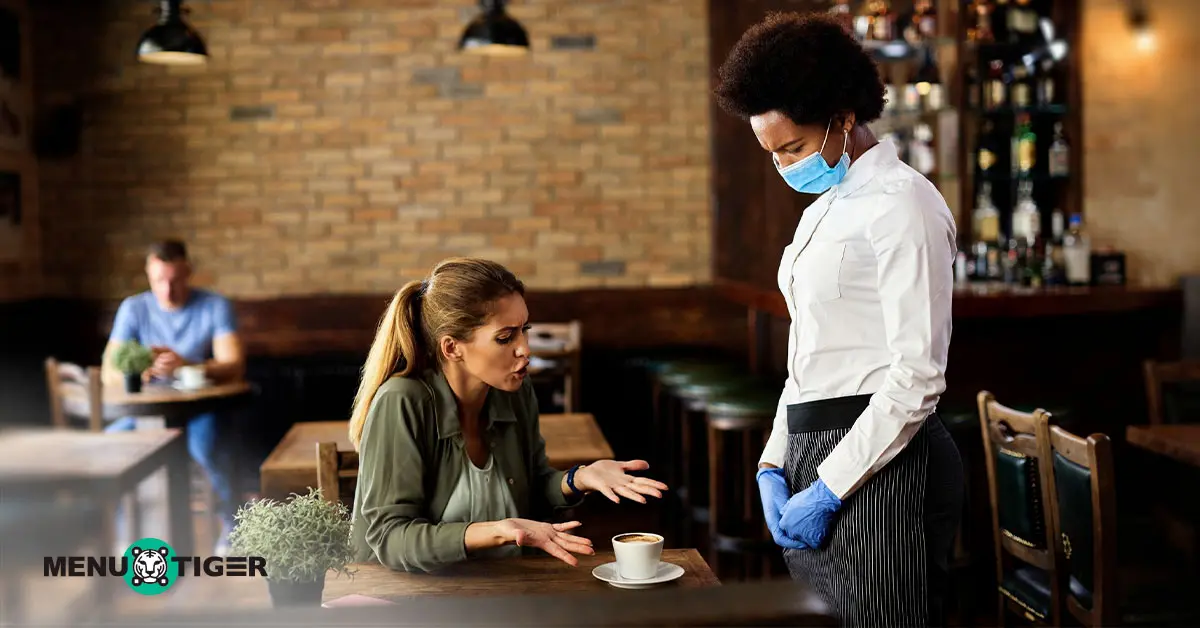
Many restaurant service failures occur due to poor coordination between FOH and BOH teams.
Common issues include:
- Incorrect orders
- Missing menu items
- Delayed food service
- Poor allergy communication
- Inconsistent food quality
- Hygiene and sanitation failures
While some of these issues may seem minor, they can quickly escalate into serious consequences, including customer dissatisfaction, reputational damage, legal risks, and loss of trust.
Case 1: Food safety failure in service operations
One of the most widely reported food service incidents involved the death of a 13-year-old who suffered a fatal anaphylactic reaction after consuming a hot chocolate from Costa Coffee in East London on 8 February 2023.
According to findings from the East London Coroner’s Court, as reported by ITV News on 16 August 2024, the drink was intended to be prepared with soya milk due to her severe dairy allergy. However, a failure in communication between restaurant staff and the customer’s mother resulted in the allergy requirement not being properly recorded and followed during preparation.
As a result, the drink was mistakenly made using cow’s milk instead of soya milk. After consuming the drink, she experienced a severe allergic reaction and tragically passed away within hours.
Investigations highlighted breakdowns in:
- Allergy communication
- Order recording accuracy
- FoH–BoH coordination
- Verification procedures
This case demonstrates how even a small communication failure between FoH and BoH can lead to life-threatening consequences.
5 best practices for seamless front-of-house restaurant and back-of-house coordination
1. Use a restaurant order management system
A restaurant order management system serves as an integrated ecosystem for managing and organizing customer orders across Front of House (FOH) and Back of House (BOH) operations.
Here’s how the ordering process works systematically:
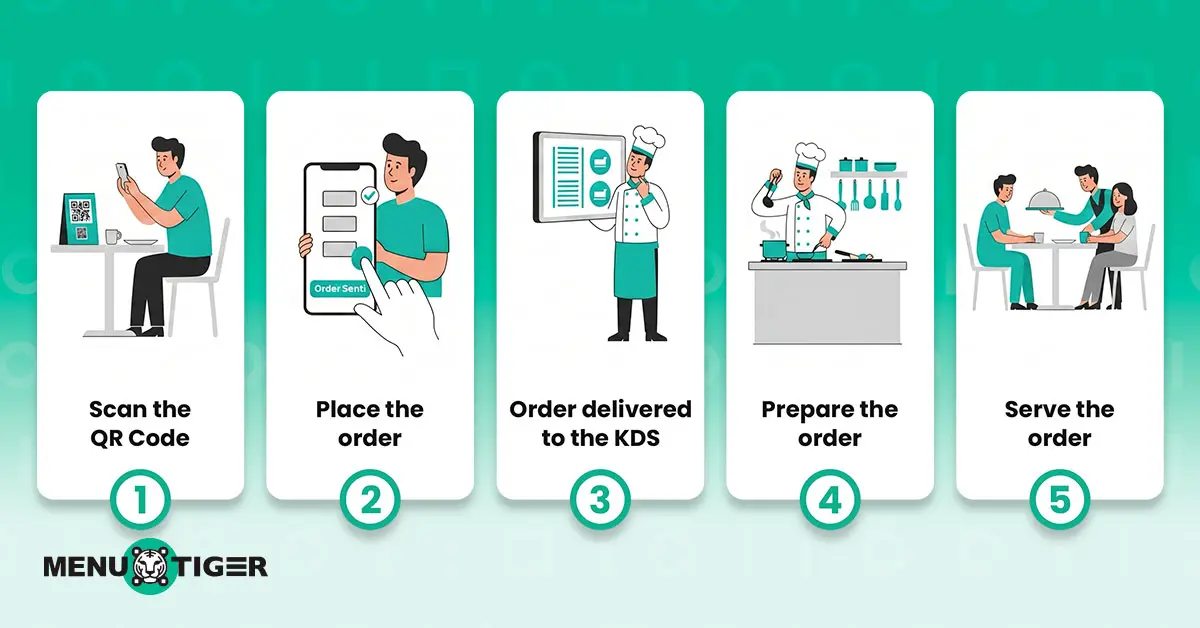
This promotes independent and organized ordering while reducing human errors and miscommunication between FOH and BOH teams.
As a result, restaurants can improve order accuracy, speed up service, reduce delays, and provide a smoother dining experience for customers.
2. Apply the “Swapped” method
The “swapped” method does not mean FOH staff become BOH staff or vice versa. The moral focuses on building mutual understanding between both teams so they can work with greater empathy and accuracy.
The goal is to help both teams understand each other’s workflows, challenges, and operational limitations, improving coordination, customer feedback handling, and overall communication while reducing misunderstandings.
To achieve this, restaurants should implement scenario-based training that involves both teams working together to solve real service challenges such as peak-hour rushes, incorrect orders, allergy requests, or delayed kitchen output.
This approach strengthens teamwork, improves coordination, and ensures that FOH and BOH are aligned in delivering a smooth and efficient dining experience.
3. Integrate value-based behavior
This means restaurant culture and values must be embedded into every stage of the restaurant operation, from hiring to daily execution.
For example, if your core operational value is “speed and accuracy,” this must be systematically integrated across the board:
- Hiring process – Assess candidates on speed, accuracy, and ability to handle pressure through scenario-based questions.
- Training process – Use real-service simulations to reinforce speed and accuracy in FOH and BOH tasks.
- Daily operations – Track performance using metrics like order accuracy, prep time, and service speed.
- Feedback system – Conduct regular reviews to ensure staff consistently meet core value standards.
By integrating values into hiring, training, execution, and evaluation, restaurants can turn principles into consistent operational behavior.
4. Hold daily pre-shift briefings
Alignment is everything. It is not back of house vs front of house, so managers must align FOH and BOH before each shift on menu changes, item shortages, limited-time promotions, expected busy hours, and special VIP reservations or allergy instructions.
Beyond the verbal meeting, creating a shared digital communication channel that includes all FOH and BOH staff ensures information is shared quickly and accurately.
This allows team members to easily access important updates whenever they need to review or recall information, reducing miscommunication during peak operations.
5. Introduce order verification steps
Order verification is a restaurant safety best practice and a critical control point that helps prevent mistakes before they reach the kitchen or the customer.
This process ensures that every order is accurate, complete, and clearly communicated between FOH and BOH.
A simple verification workflow may include:
- FOH reviewing the order with the customer before submission
- POS system validation to ensure all items and customizations are correctly logged
- BOH confirming details on the kitchen display system before preparation begins
- Final check for high-risk orders (e.g., allergy requests, special dietary needs)
This improves accountability, ensuring both FOH and BOH share responsibility for order accuracy and customer satisfaction.
Pro tip: Train staff on the most common dietary restrictions and food allergies to help ensure accurate order verification and safer food preparation.
Turn the front of house vs back of house into one smooth line.
FOH and BOH teams work toward different outcomes, but both ultimately support the same goal: a successful and profitable restaurant.
FOH focuses on guest experience, service quality, and customer engagement, while BOH focuses on food preparation, consistency, and operational efficiency.
When these two teams are properly aligned, especially with the right restaurant management system, the result is faster service, fewer errors, improved communication, and a significantly better overall dining experience, bridging the gap between front of house vs back of house.
FAQs

Eulla
Eulla joined MENU TIGER’s Content Team with a foundation in English teaching. She combines language expertise and creativity to produce engaging content that educates audiences and drives meaningful results.
Affiliates





© 2026 Menu Tiger. All rights reserved


